
The Bible is a message from God to humanity, so we're told.
It should be a clear message.
Not "deep," not "open to interpretation," not something that needs experts and scholars and centuries of debate to figure out.
Because clarity is what perfection looks like in communication.
If I give you directions to my house and you follow them and you end up in a different city (because you don't understand my words), you would not call my directions "perfect." You'd call them confusing, or just bad.
 Now apply that same basic standard to the Bible, which they say comes from an all-knowing all-powerful "perfect" source.
Suddenly the rules change. Now confusion becomes "depth."
That's very convenient. Christians say their message is perfect -- not just good, not just meaningful, but perfect. A perfect message from a perfect being.
But we look at what's going on in the world --- thousands of denominations with different interpretations of the same text --- people reading the same text and coming to completely different conclusions. Some see strict rules. Others see symbolic meaning. Some say that a passage is literal, and others say that it's a metaphor (Matthew 18:9).
Each interpreter thinks he's absolutely right.
Think about something simple ... traffic lights. Red means "stop" and green means "go." There's no debate and no interpretation and no confusion. You don't find philosophers arguing about whether red really means "stop" or if it's just symbolic, because the message is clear. It's designed to be understood the same way by everyone.
Now compare this to the Bible. One verse says one thing; another verse says something else. Instead of questioning the message, people blame the reader. "You misunderstood it." But if millions of people misunderstand it in the same way, at what point should we start to question the message itself?
A perfect communicator would not design a message that depends on perfect interpretation. That's not how communication works.
Let's look at Christianity, where Protestants, Catholics, and hundreds of other groups disagree on salvation, church leadership and authority, rituals, the nature of God, and even basic beliefs about what God wants from us. Some believe that faith alone saves you; others say "works." Some people pray to Mary; some say that's wrong.
It's the same book, with people drawing multiple conclusions. Some take things literally and others say that the context matters. The Bible is a message that claims clarity but produces confusion.
Apologists will say that the message is perfect but humans are flawed. This sounds reasonable, but think about it:
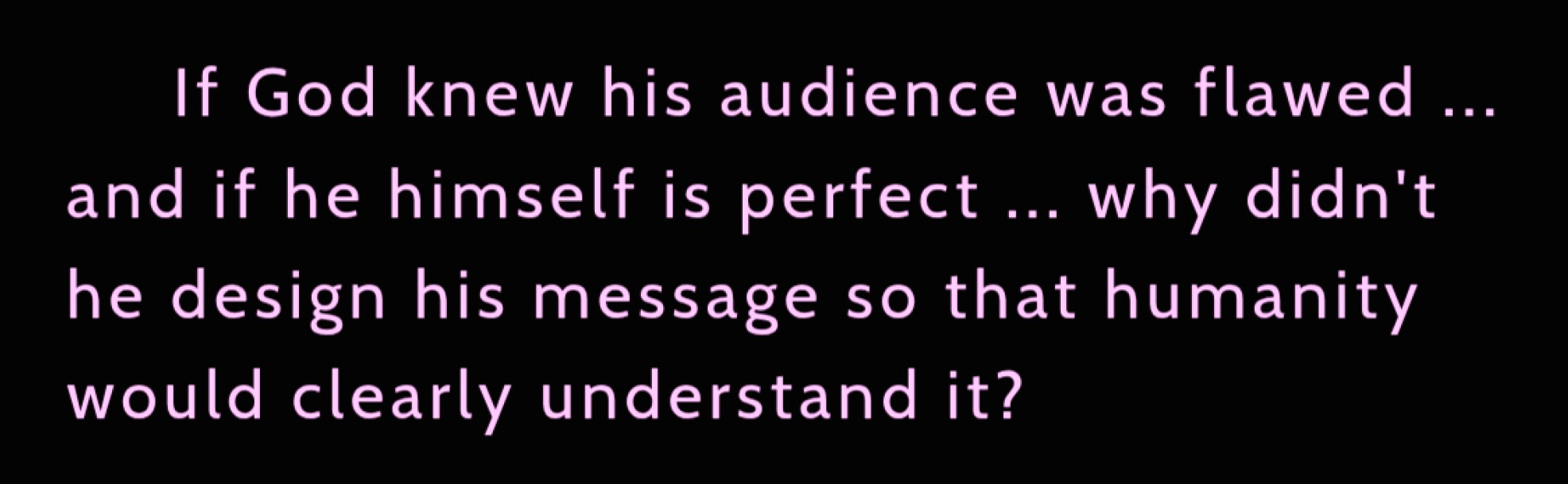
That's what a good communicator would do.
A teacher shouldn't blame his students if he can't teach them properly. A good teacher explains and uses examples and removes ambiguity.
A good teacher would stay after class and answer students' questions. A good teacher wouldn't just write a textbook and then vanish for thousands of years.
When a message consistently leads to confusion and disagreement and division, blaming the listeners starts to sound like an excuse, especially when the teacher claims to be perfect.
Imagine a company that releases a product manual. Half of the people use it correctly, and half of the people use it differently. A lot of people damage the product because they misunderstood the instructions. Should the company say that their manual is perfect but the users are flawed? No. The company should rewrite the manual. But religious text are never rewritten for clarity. Instead we get commentaries from "experts."
Volume 1 of a book entitled Exposition of Ephesians -- Ephesians being a book of the Bible that is eight pages long --- is 628 pages long. Volume 2 is only 504 pages long.
Eight pages of Bible text... and a Christian scholar thinks we need 141 pages of commentary per page to understand it!!!
Ordinary people are told to trust the correct interpretation. But who decides which interpretation is correct?
Usually it's the group that you already belong to. Truth becomes something you inherit, not something that is clearly delivered. A perfect explanation doesn't need layers of explanation to be understood. It should not require historical context and linguistic analysis just to avoid misunderstanding. If the basic ideas of a message depend on interpretation, it stops being stable. It becomes flexible. Flexible messages can be shaped to fit almost anything. That's why the Bible can be used to justify kindness or cruelty, peace or conflict, freedom or slavery. It all depends on how you read it.
The power isn't in the message; it's in the interpretation.
If the meaning can change depending on who reads it, can we call the message "perfect," or is it just vague enough that it survives any interpretation? There's a big difference between something being deep and something being unclear, and calling confusion "depth" doesn't solve the a problem. It just hides it
People will say that you have to apply context, but that simply means that the message is a puzzle. Instead of clarity, you get dependency. You're no longer just reading a message; you're relying on someone or something else to interpret. A perfect message should not require a middleman. It should apply to all people across all the centuries. It should be understandable without specialists to decode it.
If a warning label says "HOT -- DO NOT TOUCH," you don't need a historian to explain what "hot" meant in ancient Israel. You understand the message instantly. That's what clarity is. Now compare that to the Bible, which requires centuries of commentary just to let us know what it's really saying -- interpretation layered upon more interpretation.
If interpretation is necessary , then disagreement becomes inevitable, because people don't interpret vague things the same way. When a message requires interpretation, then confusion is built into the system.
Moral rules should be clear if they come from a perfect source. Some people read the Bible and conclude that there are principles that never change -- gender roles, justice, slavery, punishment. All sides claim that they are following the true meaning.
With the Bible, disagreement should be rare, not normal. And yet disagreement seems to be the default, and agreement is the exception.

|

|