
Every year at Easter I wonder: Why does forgiveness require torture? What kind of love charges pain as payment?
 Easter isn't a story about love. It's about a transaction.
Picture this: It's Good Friday in South America. There's a processional parade in the street. The entire city slows down. The air is thick with incense and melted wax and dying flowers.
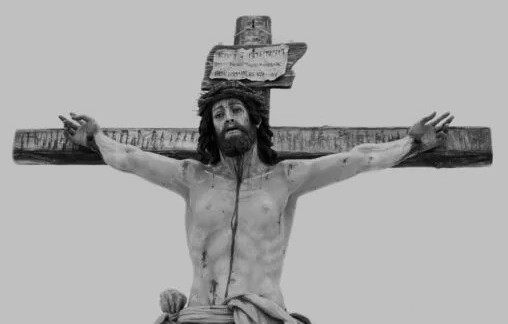
Thousands of people move in silence through narrow streets, following a statue of a broken man. His body is torn up. His head is crowned with thorns. His side has been pierced by a spear. Women are crying. Children are watching, confused.
No one stops to ask the obvious: Why are we celebrating this?
Step outside the story for a moment. Imagine someone who has never heard of Christianity. He's never been inside a church. He's never been taught what this means. What does he see? A public ritual built around an execution. A crowd of people emotionally attached to an instrument of torture. People thanking a god who allowed his son to be killed.
That observer wouldn't call it majestic. He'd call it horrifying.
But you don't see it that way, because an idea was placed inside you before you were able to question it.
You were told that this death was necessary, that it was love, that it was done for you, "to save you," and that phrase for is so powerful that it shuts down the one question a free mind would ask:

Easter doesn't invite you to think. It invites you to have emotion. It surrounds you with music and ritual and collective emotion, and when you're inside emotion, you don't analyze.
If you stop for one second and actually look at what's being said, you'll notice something uncomfortable. At the center of all this "beauty," there isn't a message of love. There's a structure of debt.
Let's strip away the music and the candles and the sad songs and look at the doctrine as it is actually taught. It is substitutionary atonement, and it says something very simple: Someone had to pay, so Jesus paid with his body and with his blood with his suffering.
Now ask yourself honestly: Does this sound like love, or does it sound like a transaction?
Here's the logic, step by step: You're born into debt. You start off with a cosmic parking ticket, a stain, not because of something you did, but because of something two people supposedly did at the beginning of time in the Garden of Eden. That stain is called Original Sin, and that stain creates a a debt toward God. Why? Because God's honor was offended, his feelings were hurt, his authority was challenged, his rules were violated.
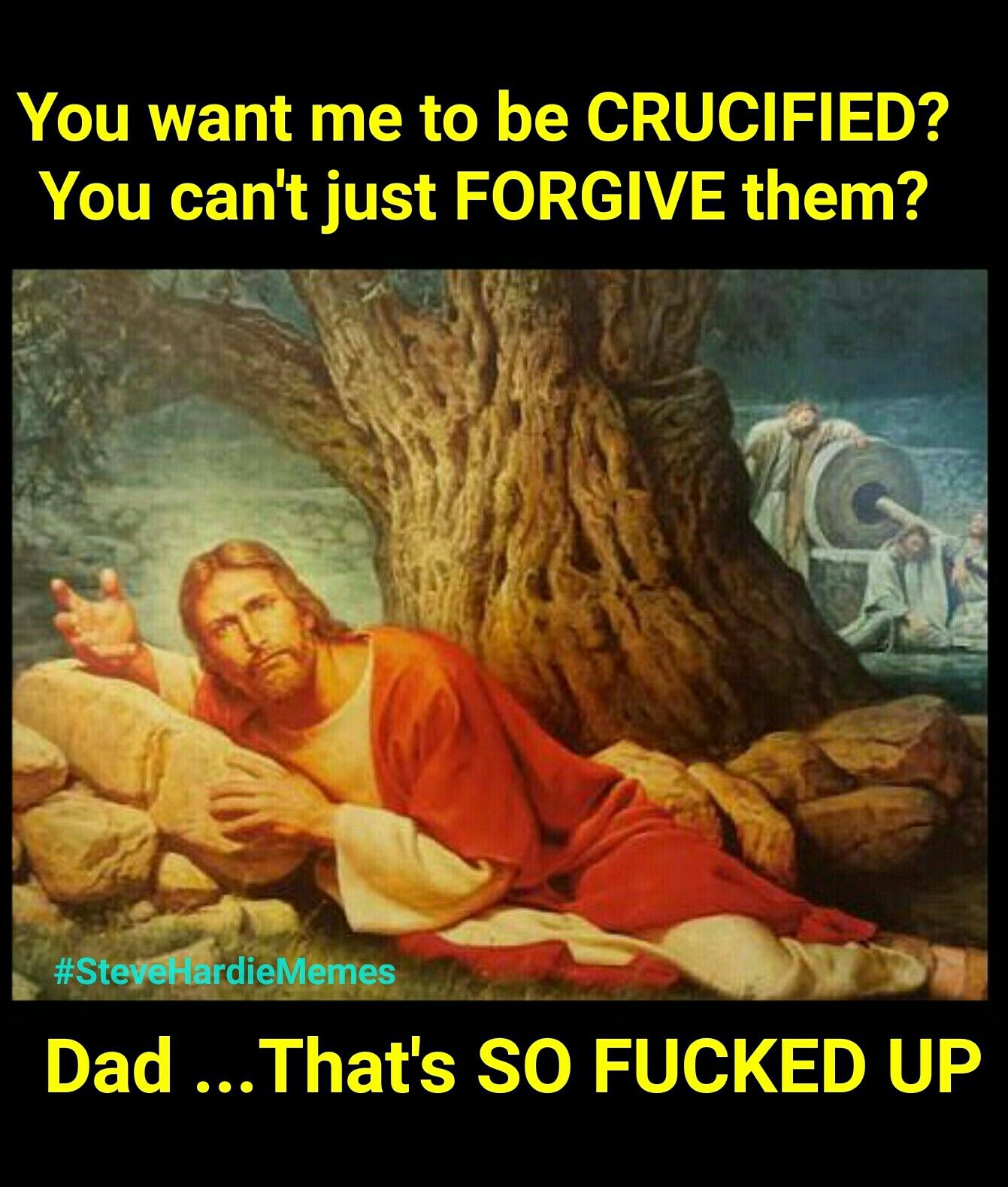 According to this system, a just God cannot simply forgive. He has to collect, because if he forgives without payment then he's not "just." And if he's not "just" then he's not God. The system defines God in a way that makes forgiveness impossible without violence.
It's a God who cannot let go unless he sees suffering, a God who needs blood before he stops being vengeful, and because no human is pure enough to pay an infinite debt, the solution becomes: God sends his own perfect son to suffer in your place.
That's the mechanism: One person owes a debt, and another person has to pay it.
Now say that out loud ... without background music, without emotion, letting your reason guide your interpretation. Explain it like you would to someone who has never heard it before.
God created humans. Humans failed. They violated God's rules (some of which are weird and artificial), and instead of forgiving the humans, God demanded the torture and execution of his own son to make the penalty payment for sin.
When you say it like that, it doesn't sound sacred. It's a payment system. It damn sure isn't "forgiveness."
The logic begins to crack. Because if God is truly omnipotent, then he had another option: He could forgive without blood. Honestly, he could erase the debt with a simple decision. He could simply say, "You are forgiven," but he didn't. The system says that he can't, which means God is not actually free. He is bound by a rule that demands suffering as currency.
So what you're looking at is not justice. It's a system that can't function without victims ... a system that requires death and blood in order to operate.
And the most disturbing part isn't that this idea exists ... it's that we were taught to see it as beautiful. We were taught to feel grateful for it, grateful for the nails, grateful for the blood, grateful for the suffering, and no one stopped to ask the question that breaks everything: What if there was never a debt to begin with?
Let's take this one step further: Strip away every layer of emotion, every ritual, every inherited belief, and just say the story as it is ... God creates humans. And then, in all his omnipotence and wisdom and love, instead of forgiving them — despite all his infinite power — he requires the torture and death of his own son before forgiveness is possible.
That's the structure, and once you say it clearly, without decoration, something inside it collapses, because it doesn't sound like love anymore. It's a system that enforces payment.
The moment you start asking where this an idea actually came from, you run into something that most people don't realize: The idea that Jesus died to pay for your sins did not come from Jesus Christ himself. Go back to the earliest accounts (the synoptic gospels). Look at what Jesus actually preached. Jesus isn't a man obsessed with his own death as some sort of cosmic payment. You find a Jewish teacher talking about justice and compassion and the kingdom of God, about helping the poor, about rendering to Caesar, a radical ethical voice ... but he doesn't clearly present himself as a sacrificial payment designed to settle some universal debt. That idea comes later (John's gospel and Paul's letters).
Paul never met Jesus and never heard him teach. What Paul did with the death of Jesus is one of the most influential moves in the history of ideas. Paul takes a political execution and gives it an entirely new meaning. He transforms it into the center of a new theology. Suddenly it's no longer about what Jesus taught during his lifetime, it's about why he died and what that death accomplishes. Paul writes that Christ died for our sins and that without that there is no salvation. It's the idea that humanity is condemned from the beginning, and only the blood of a perfect being can cancel that condemnation.
But where did Paul get this framework? Not from Jesus. He pulls it from systems that already existed, from the temple where animals were sacrificed to atone for wrong, from Greco-Roman mystery cults of dying and rising gods.
"Easter" is a repulsive horror story.

|

|